
Failure Mode and Effects Analysis (FMEA) and Failure Mode, Effects and Criticality Analysis (FMECA) are foundational methodologies for identifying potential design flaws, process bottlenecks, and mission-critical hardware failure risks. ALD’s RAM Commander delivers two dedicated software engines tailored to distinct industry standards and life cycle stages.
Depending on your industry domain—automotive, medical devices, defense, aerospace, or industrial manufacturing—reliability standards govern whether you require RPN-based Potential FMEA or Quantitative Hardware/Functional FMECA.
Potential Failure Mode and Effects Analysis is widely applied during design (DFMEA) and manufacturing process development (PFMEA). It provides structured risk assessment across commercial, medical, and industrial hardware/software systems.
AIAG / VDA, QS-9000, SAE J1739, IEC 60812, JEP131, ISO 14971 (Medical Devices).
- Calculates Risk Priority Number (RPN): Severity × Occurrence × Detection.
- Identifies high-risk failure modes to drive preventative & corrective action plans.
- Integrates control plans directly into manufacturing and lifecycle documentation.
- Applies universally to hardware, software, multi-tier assemblies, and service workflows.
Failure Mode, Effects and Criticality Analysis (FMECA) expands standard FMEA by incorporating rigorous criticality rankings derived from item failure rates, operating conditions, and mission impact severity.
MIL-STD-1629A, GJB 1391, GJB 1392, AIR FORCE SMC REGULATION 800-31.
- Quantifies failure effect severity based on empirical component-level failure rates.
- Seamlessly shares product tree data with Reliability & Maintainability (R&M) modules.
- Includes built-in Testability Analysis to validate fault detection and isolation.
- Essential for safety-critical aerospace, defense, telecom, and railway platforms.
Inspect real workspace layouts generated within ALD's RAM Commander software environment.
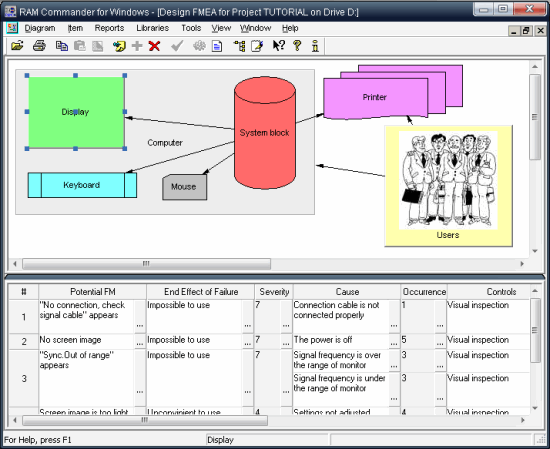
Hierarchical RPN calculation, severity ranking, and action item tracking interface.
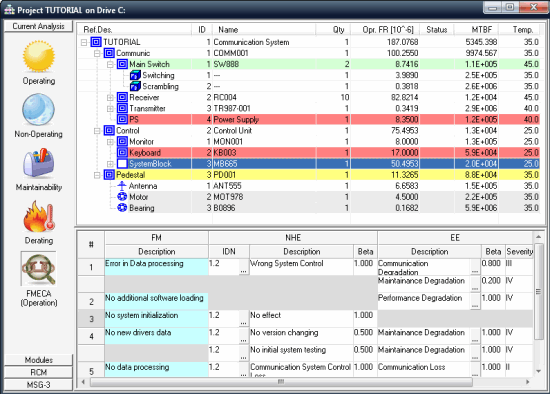
Quantitative failure rate distribution, criticality matrix, and fault diagnostic isolation.
Yes. RAM Commander uses a unified product breakdown tree. Any bill of materials (BOM) created for MTBF predictions, RBD, or Maintainability can be directly shared with the FMECA engine without duplicate data entry.
Yes. RAM Commander’s Potential FMEA module includes custom severity and risk matrices compliant with ISO 14971 requirements for medical device risk assessment and post-market surveillance.
Let ALD's expert reliability engineers perform complete FMEA/FMECA analysis, safety assessments, or MTBF predictions for your organization.
Contact Reliability Services